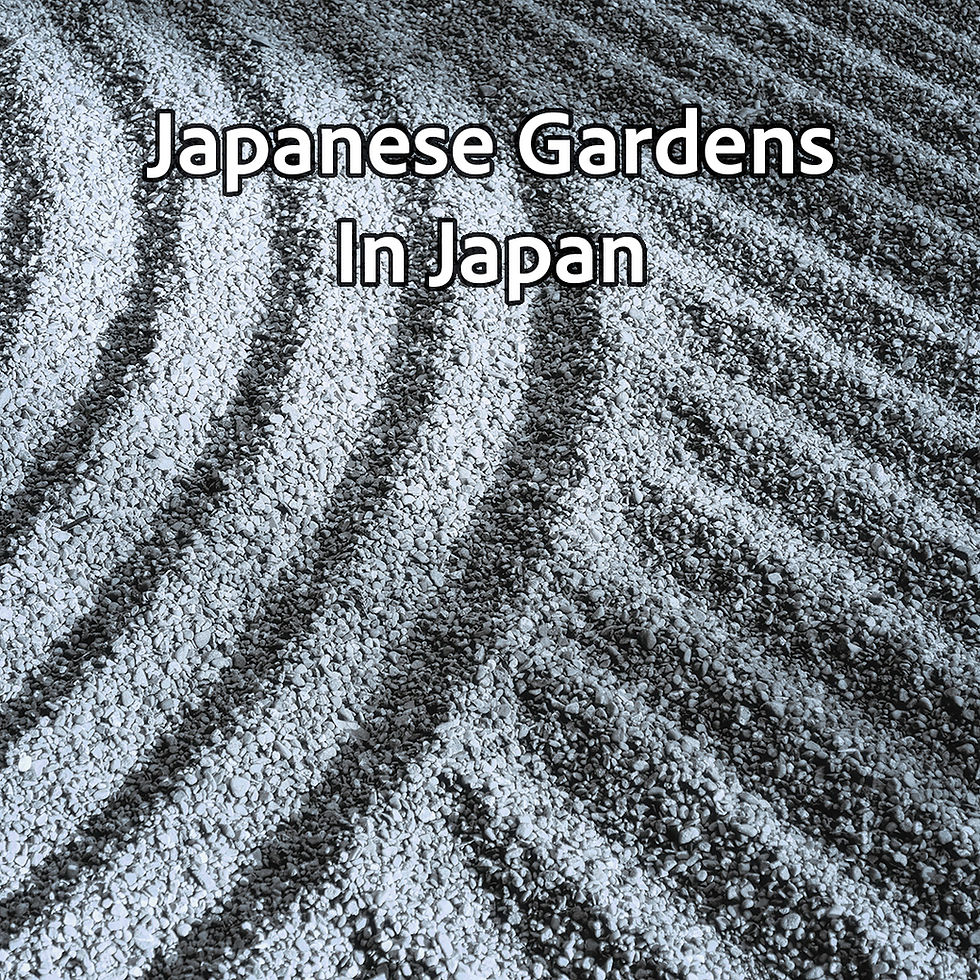
Tofuku-ji Temple, Kyoto

Stone Seas, Maple Valleys, and Zen Gardens

At Tofuku-ji Temple, Kyoto, water is everywhere, even when it is not present. It is heard in the raked white gravel of the Hojo South Garden. It is remembered in the “Eight Seas.” It moves below Tsuten-kyo Bridge in the maple-filled ravine.
For those who love Japanese gardens, Tofuku-ji Temple, Kyoto is not a place to hurry through. It is a place to walk slowly, stop often, and let the design reveal itself in layers. The temple is famous today for autumn color, but its deeper strength lies in the way architecture, ravine, and garden speak to one another.
The Hondo: A Still Center Before the Gardens
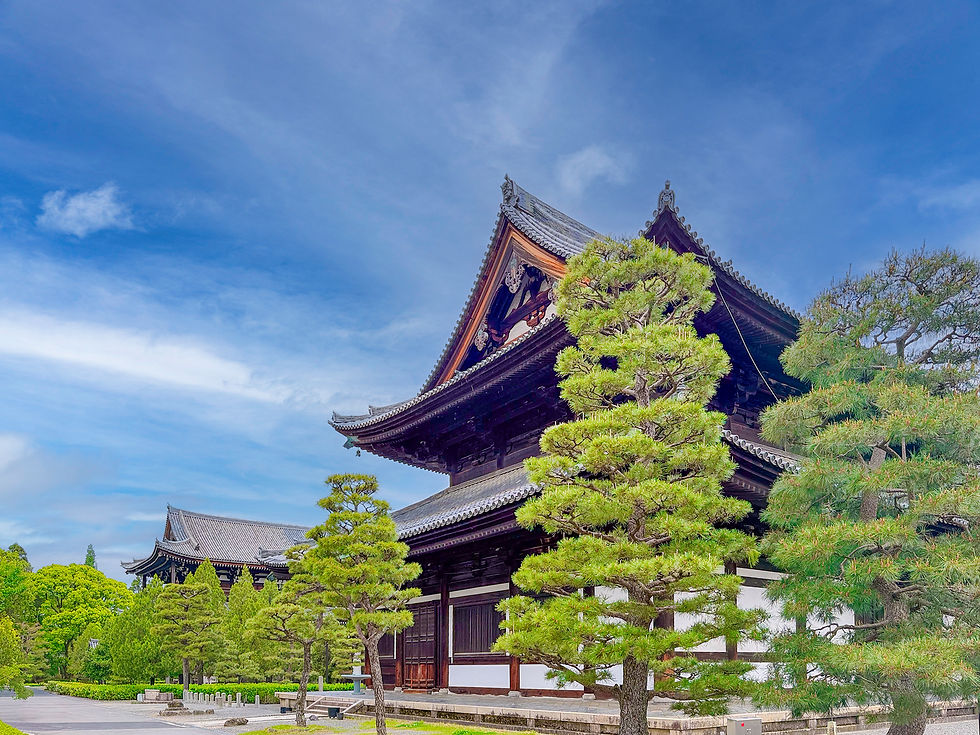
The Hondo, or main hall, stands as one of the visual anchors of Tofuku-ji. The present Hondo serves as both Butsuden and Hatto and was built in 1934, during the Showa period, as a grand, double-roofed irimoya structure. Its Blue Dragon ceiling painting was created by Domoto Insho, and during the spring Nehan-e observance the temple displays a large Nirvana painting by the painter-monk Kichizan Mincho.
For the garden visitor, the Hondo is important not only as a building, but as a pause. It reminds us that these gardens were not made as decorations. They belong to a Zen temple, to ritual space, and to a rhythm of sitting, walking, viewing, and returning to stillness.
The Hojo South Garden: The Sea Without Water
The Hojo, the former abbot’s quarters, is where Tofuku-ji becomes especially powerful for garden lovers. The current Hojo was rebuilt in 1890 after the Meiji-period fire of 1881, and its surrounding gardens were later completed by Mirei Shigemori in 1939. The four gardens arranged around the east, south, west, and north sides of the Hojo are known as Hasso-no-Niwa, a name connected with the eight important events in the life of the Buddha. In 2014, the garden was registered as a nationally designated Place of Scenic Beauty under the name Tofuku-ji Honbo Garden.
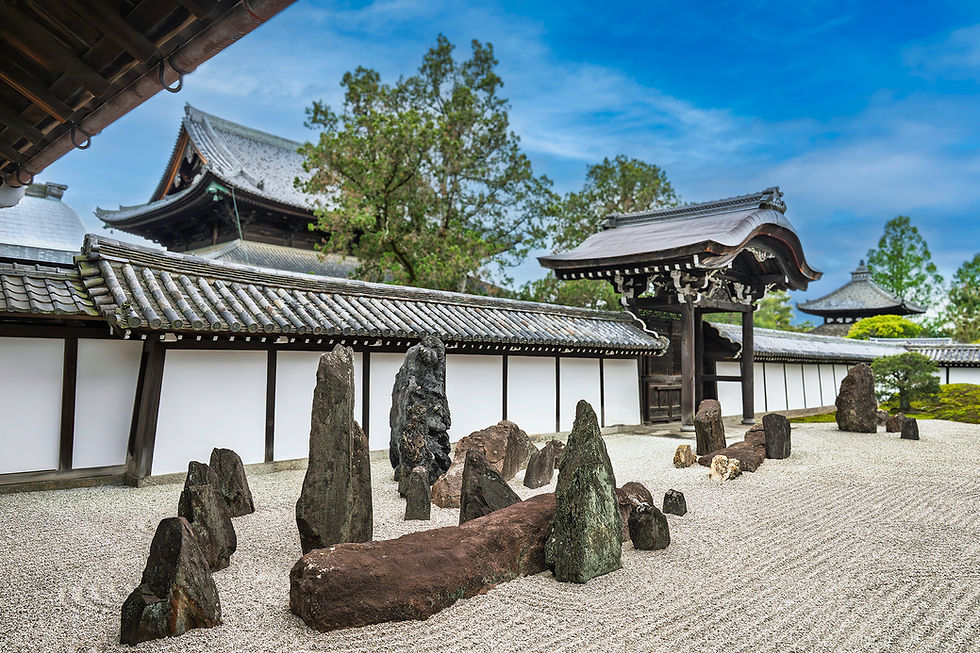
The South Garden is the most expansive and dramatic of the four. In the white sand, Shigemori placed powerful stone groupings that represent the four mythic islands of Horai, Hojo, Eiju, and Koryo. The raked sand expresses Hakkai, the Eight Seas, while five moss-covered mounds to the west represent the Kyoto Gozan, the Five Mountains.
This is a garden built on restraint, but not emptiness. The rocks carry weight. The sand carries motion. The moss carries age. The South Garden gives the viewer a whole world through very few materials. There is no pond, yet the mind supplies water. There are no waves, yet the gravel has movement. There are no distant islands, yet the stones create distance.
It is also a modern garden with ancient manners. One condition placed on the design was that materials already within the temple grounds should not be wasted. That constraint helped produce some of the garden’s most inventive forms, including reused stonework within the Hojo garden composition.
For anyone interested in Japanese gardens, this is one of Tofuku-ji’s great lessons. Tradition does not always mean imitation. Sometimes it means taking old principles seriously enough to let them live again in a new form.

The Hojo North Garden is one that shouldn't be missed. The famous Checkerboard Garden of moss mounds and stone is one of Shigemori's more popular design elements.
Nine Mountains and Eight Seas: Reiun-in’s Cosmic Garden
There is another garden in the Tofuku-ji world that belongs in this conversation: the Nine Mountains and Eight Seas Garden, known in Japanese as Kusen-Hakkai-no-Niwa, at Reiun-in, a Tofuku-ji sub-temple. This is separate from the Hojo South Garden, though the two share a language of mountains, seas, and Buddhist cosmology.
Reiun-in was founded in 1390 as a Tofuku-ji sub-temple. Its karesansui garden was restored in the postwar period by Mirei Shigemori and includes two gardens: the Nine Mountains and Eight Seas Garden, with the Iai-seki stone associated with the monk Shosetsu, and the Gaun Garden. The garden may also be viewed from the two-story Kangetsu-tei tea house.
The Nine Mountains and Eight Seas garden at Reiun-in Temple Pagoda section of The Nine Mountains and Eight Seas garden at Reiun-in Temple
Views of the Nine Mountains and Eight Seas garden at Reiun-in Temple, Kyoto
The “Nine Mountains and Eight Seas” name points toward a Buddhist vision of the universe, with Mount Sumeru at the center of the world. The garden holds that cosmic idea in the simplest garden language: stone, sand, shape, and silence.
The effect is different from the Hojo South Garden. The Hojo garden opens wide, with broad gravel space and strong island stones. Reiun-in feels more intimate, more inward. It is a garden to sit with. It asks the viewer to consider not just scenery, but order: what is at the center, what surrounds it, and how the mind gives shape to the unseen.
Tsuten-kyo Bridge: A Garden of Leaves and Air
If the Hojo gardens show the sea in sand, Tsuten-kyo Bridge shows the garden as air, height, and seasonal color. Built in 1380 by Shun’oku Myoha, the bridge corridor connects the Hondo area to the Kaisando and crosses the Sengyokukan ravine.
Tsuten-Kyo Bridge at the Tofu-Ji Temple, Kyoto Looking out from the Tsuten-Kyo Bridge at the Tofu-Ji Temple, Kyoto
Views of the Tsuten-Kyo Bridge are why many visit the Tofuku-Ji Temple in Kyoto Japan
This is the view many visitors come for, and with good reason. From the bridge, maples rise upward out of the ravine until the leaves seem almost level with the walkway. In spring and early summer, they form a soft green cloud. In autumn, they become a red and gold sea.
The rare golden three-lobed maple associated with this area is said to descend from a Chinese maple brought from Song China by Shoichi Kokushi. Whether seen in fresh green or autumn color, Tsuten-kyo is less a bridge over a garden than a bridge through one.
Sokushu-in: Moss, Memory, and the Old Tsukinowa Villa
Sokushu-in is one of the quieter Tofuku-ji sub-temples, and it carries a different kind of atmosphere. Its official history identifies it as a Rinzai Tofuku-ji sub-temple founded in 1387 by Shimazu Ujihisa, with Gochu Genju, the 54th abbot of Tofuku-ji, as founding priest. The temple became connected to the Satsuma domain and took its name from Ujihisa’s posthumous Buddhist name.
For garden enthusiasts, Sokushu-in is important because of its connection to Tsukinowa-dono, the villa site associated with Fujiwara Kanezane. The garden occupies ground with an 800-year history, was restored in 1977 under the guidance of garden scholar Mori Osamu, and was designated a Kyoto City Historic Site. It is described as a rare late-Muromachi garden of aristocratic shinden-zukuri character, with a pond layout suggesting the older form.
The entrance gate to Sokushu-in Temple, Kyoto, Japan Meditation room at the Sokushu-In Temple, Kyoto Japan
The Entrance gate and meditation room of Sokushu-in Temple
Sokushu-in feels like a place where garden and history are not separate subjects. The moss is not simply green. The stones are not simply arranged. The garden rests over older ground, and the visitor senses that beauty here has survived by being cared for again and again.
Reigen-in: Green Shade, Jizo, and a Garden Made to Walk Slowly

Reigen-in is for those drawn to quieter spaces. It is a sub-temple of Daihonzan Tofuku-ji, located near Tofuku-ji’s north gate. The temple traces its origin to the Enbun years, 1356–1361, when it was founded as Tengo-an by Ryusen Osho, a son of Emperor Go-Daigo. Around 1400, after Ryusen’s death, Zaisen Kijo renamed the temple Reigen-in, the name it carries today.
Reigen-in also holds a layered martial history. During the Honno-ji Incident in 1582, the temple sheltered Mizuno Tadashige, a warrior from what is now Kariya in Aichi Prefecture. This began a lasting connection with the Mizuno family, and the grave of Mizuno Katsunari, the first lord of Fukuyama Castle, remains within the temple cemetery.
Reigen-in’s appeal rests in its gentle scale. The temple’s modern garden area is known collectively as Suiin-en, a name chosen for the green shade of the trees and the small Jizo figures tucked throughout the grounds. In 2020, Sone Zoen renovated the garden in front of the main hall, Fuo-den, creating the Komorebi-no-Niwa, or “Garden of Sunlight Filtering Through Trees.” The garden was made so visitors could walk within it, not only view it from a fixed point.
The six Buddha's of Reigen-in Temple Waterfall in the inner garden at Reigen-in Temple, Kyoto Japan
Reigen-in Temple is one of the more intimate gardens within Tofuku-ji Temple precinct.
Reigen-in is a graceful counterpoint to the grand abstractions of Tofuku-ji’s Hojo South Garden. Where the Hojo gives us seas, islands, and sacred mountains in sand and stone, Reigen-in offers shade, trees, small stone figures, and the feeling of being gently led through the space. Its Jizo are not ornamental afterthoughts. They were dedicated with prayers for children’s health, and they give the garden a tender, human presence.
Reigen-in is a reminder that Japanese gardens can speak just as clearly in a whisper as they do in a grand Zen composition.
Zenne-in: A Small Temple with a Sounding Past
Zenne-in, also written Zennei-in, is another Tofuku-ji sub-temple and adds a quieter cultural note to the garden walk. Zenne-in was founded during the Daiei era by the Rinzai monk Hoshuku Shusen as a retirement place. In 1871, Myoan-ji was merged into Zenne-in, and the temple became a root dojo of the Fuke shakuhachi Myoan line. Myoan-ji also carries connections to the komuso tradition and shakuhachi practice.
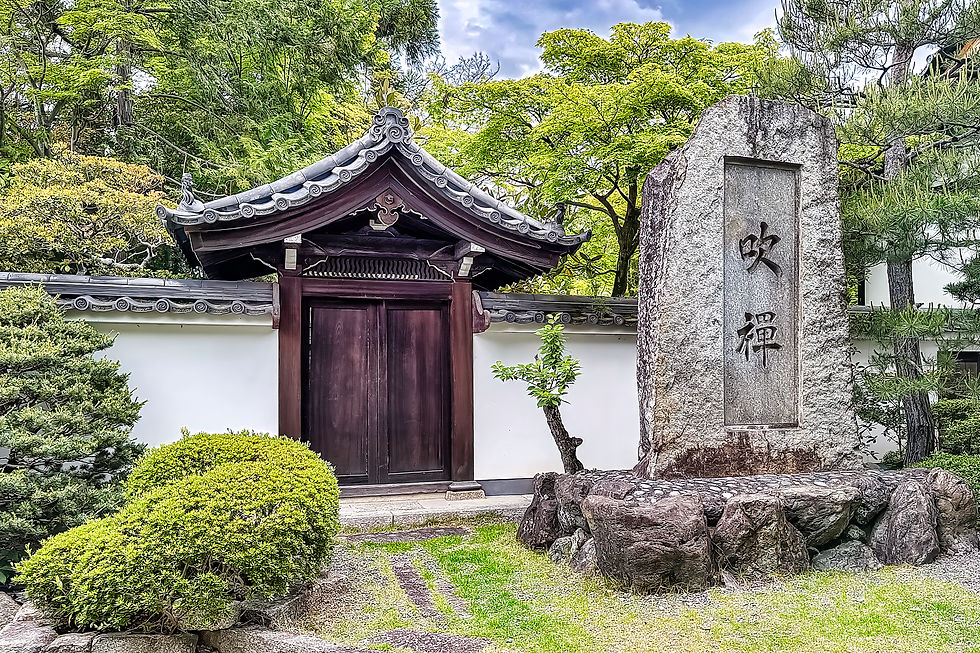
For the garden-minded visitor, Zenne-in is more modest and less widely documented than the Hojo Garden or Tsuten-kyo, but it belongs to the larger Tofuku-ji story.
There is something fitting about ending with Zenne-in. Japanese gardens are often described through sight, but they are also about sound: the rake in gravel, a gate closing, a bell, wind in leaves, a flute note fading. Zenne-in reminds us that a temple landscape is not only seen. It is heard, remembered, and carried inward.
A Garden Walk for Those Who Love Restraint
Tofuku-ji rewards the visitor who comes for more than the famous view. The autumn maples are unforgettable, but the deeper experience is found in contrast: the white gravel of the Hojo, the moss mounds of the Five Mountains, the bridge over the ravine, the older villa memory of Sokushu-in, the shaded Jizo garden of Reigen-in, the cosmic order of Nine Mountains and Eight Seas, and the quiet cultural thread of Zenne-in.
This is not a garden of one mood. It is a temple landscape of many voices. Together, they form one of Kyoto’s most meaningful places for anyone who wants to understand how Japanese gardens hold both beauty and discipline.
Part 2 of this story with sub temple gardens not shared here will follow.
For more stories on Japanese gardens, visit the Japanese Gardens page here on Koi Waters Online Magazine.


Click this Link to be taken to the Google Maps page for Tofukuji Temple, Kyoto Japan.