Mitaki-dera: Hiroshima’s Mountain Temple

A Temple of Purification and Water

Mitaki-dera: Hiroshima’s Mountain Temple sits high on the forested slopes of Mount Mitaki, northwest of central Hiroshima. One of western Japan’s most atmospheric Buddhist temples. Formally known as Mitaki-san Fudō-in, it belongs to the Shingon sect and has welcomed pilgrims for more than twelve centuries.
Here, water, forest, and prayer come together in a landscape that has changed little with time.
Origins in the Nara Period
Mitaki-dera’s history reaches back to the Nara period (710–794), with 809 AD commonly cited as its founding year. Early accounts associate the site with Saichō, the influential monk whose work helped shape Japanese Buddhism. Although the temple is now Shingon, the site’s earliest purpose has remained constant from the beginning: purification through water.
The name Mitaki, “three waterfalls,” comes from the natural springs that have defined the mountain long before halls or pagodas appeared.
• Ichinotaki
• Ninotaki
• Sannotaki
Water was revered here as a cleansing force, and the falls remain the temple’s quiet heartbeat.

A Place of Memory After the War
Mitaki-dera holds a unique role in Hiroshima’s post-war landscape. In 1951, a Tahōtō pagoda was relocated from Wakayama Prefecture and rebuilt on the temple grounds. It stands today as a memorial to victims of the 1945 atomic bombing, offering a contemplative counterpart to the city’s official monuments.
Walking the Grounds
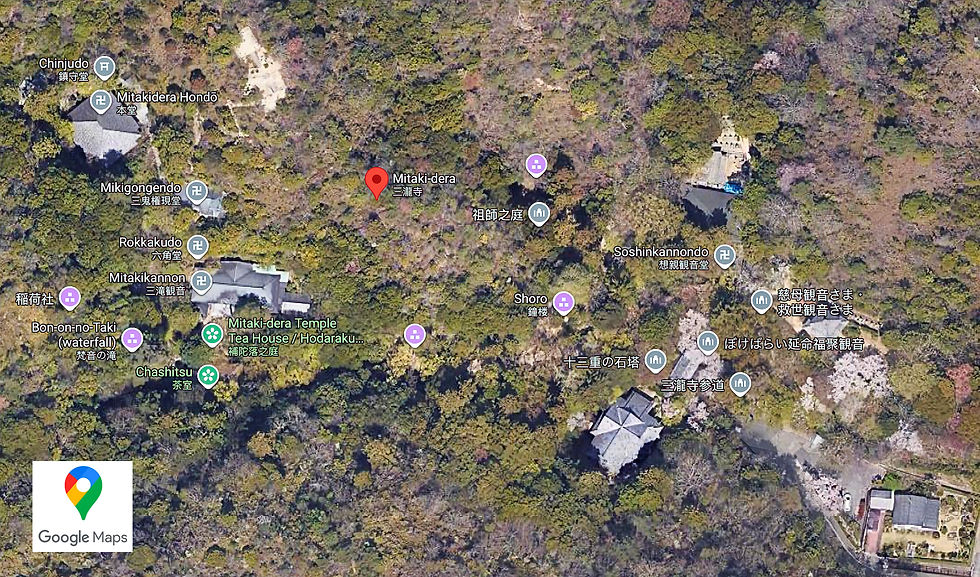
Mitaki-dera invites a slower pace. Wandering the moss-covered paths, narrow trails weave through cedar groves, crossing streams, lanterns, and wooden halls softened by centuries. Visitors encounter small Jizō statues, stone tablets, and weathered figures placed by families and worshippers over generations. Nothing here feels staged. Every stone and carving feels lived, held by time and remembered by the forest.
Why Mitaki-dera Matters
Mitaki-dera resonates differently with every visitor.
• For Buddhist devotees: a site of Shingon heritage and quiet prayer.
• For photographers: waterfalls, stonework, moss, and mountain light.
• For travelers: a peaceful retreat from Hiroshima’s urban rhythm.
Yet what visitors carry away is shared: A sense that the old ways were not erased by time—only strengthened.
An Enduring Sanctuary
In a city recognized worldwide for its tragic past, Mitaki-dera offers a gentler form of remembrance—one shaped by water, forest, and prayer. The temple’s endurance comes not from grandeur but from humility, providing a rare and steady calm to those willing to walk its shaded paths.
Location & Access
Nearest Station: Mitaki Station (JR Kabe Line)
Walk from Station: Approx. 20 minutes uphill
From Central Hiroshima: Short taxi ride or bus to Mitakiyama area, then a walk into the forest
Visitors seeking an extended experience can continue the trail up Mount Mitaki for a broad view over Hiroshima’s cityscape and inland mountains.
Monk statues at Mitaki-dera Buddhist Temple Jizu statue at Mitaki-dera temple Tsukabai fountain covered in moss at Mitaki-dera temple Stairs to bonsho bell at Mitaki-dera temple Bonsho bell at Mitaki-dera Buddhist Temple, Hiroshima Japan Mitaki-dera Temple Bonsho bell Pagoda commemorating the loss of those killed by the atomic bomb dropped on Hiroshima Prayer wishes tied at Mitaki-dera temple Building above path at Mitaki-dera temple Dragon fountain on Tsukabai at Mitaki-dera temple Upper pond with koi fish at Mitaki-dera temple One of many pathways to walk at Mitaki-dera Temple


