From Mushigame to the World: TAKO•Maru Trading and the Quiet Work of Koi Trust

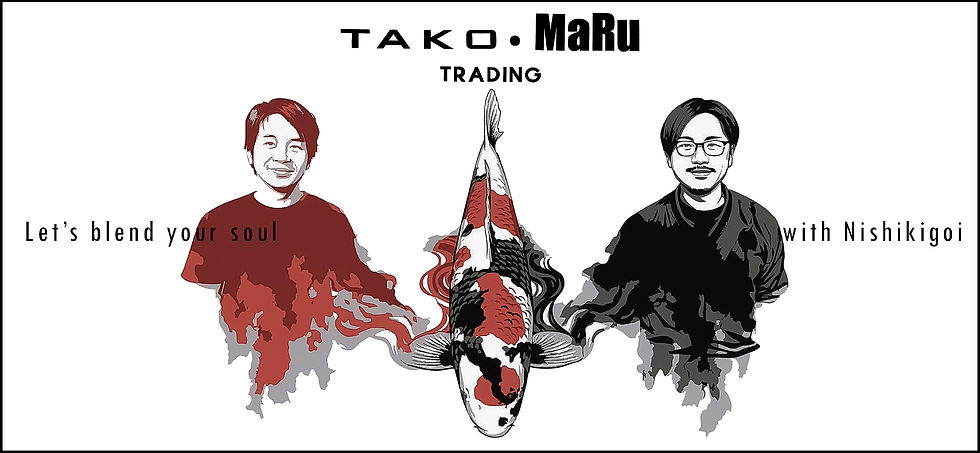
A Koi Story Rooted in Yamakoshi Mushigame
In the old mountain village of Yamakoshi Mushigame, the road does not hurry.
This part of Nagaoka, Niigata, is not simply a place where Nishikigoi are sold. It is one of the places where Nishikigoi became Nishikigoi: a living craft born from snow country, patient breeding, family farms, and an eye trained over generations.
Sitting at almost the highest point in Yamakoshi, Tako Maru Trading belongs to this landscape as a modern bridge, a koi trading and export business bringing Japanese koi to the world, with an emphasis on Yamakoshi-bred Nishikigoi and international customers.
How Tako•Maru Trading Began
Tako • Maru began much like how Koi made it from Japan to the world.
Tako, a Tamasaba goldfish dealer from Thailand, was visiting Marushin Koi Farm to purchase Tamasaba. During that visit, he and Mitsuhiro formed an easy connection. They got along well, and what began as business soon became friendship.
On Tako’s next visit to Yamakoshi Mushigame, the two men shared dinner and spoke more seriously about joining forces. That dinner became the beginning of Tako • Maru Trading, combining Tako’s koi business in Thailand with Marushin Koi Farm in Yamakoshi. What started as a friendship eight years ago has continued to grow, with both men now working to broaden their reach to the world.
What started as a friendship eight years ago has continued to grow, with both men now working to broaden their reach to the world.
That phrase, “to the world,” carries real meaning in Yamakoshi.
Marushin Koi Farm, Tamasaba, and Yamakoshi-Bred Nishikigoi
Through its connection to Marushin Koi Farm, Tako • Maru Trading carries a story deeply tied to Yamakoshi’s breeding tradition.
Marushin Koi Farm is owned by Mitsuhiro Tanaka and is known for specialties that include Doitsu Showa, Ginrin Showa, Showa, Ginrin Budogoromo, hi Utsori, Budogoromo, and Tamasaba.
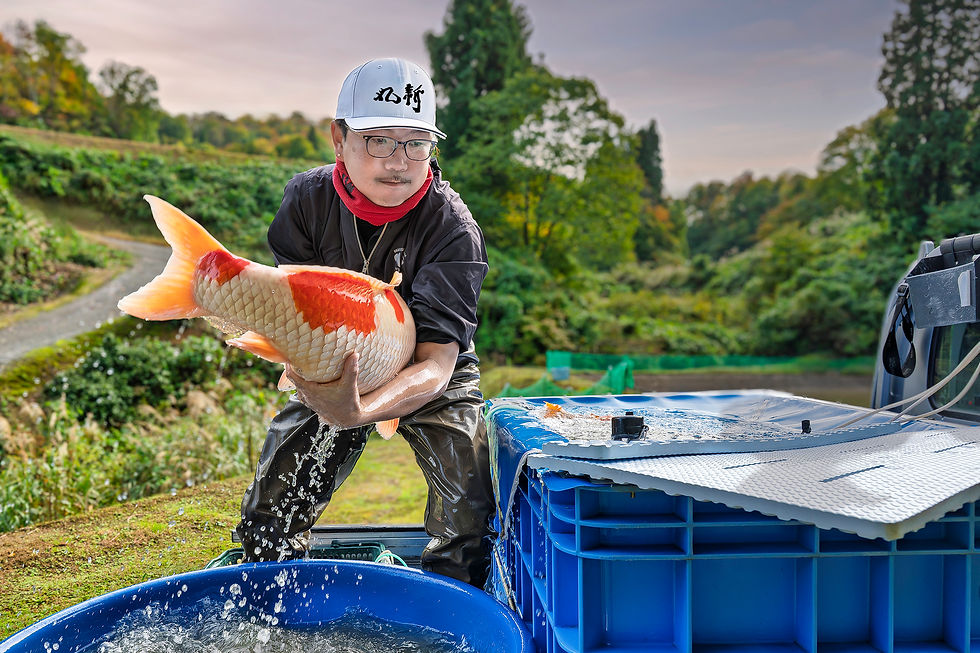
For koi keepers, those details matter. A koi is never only a variety name. It is the result of a farm, a bloodline, a season, and a breeder’s judgment. The name behind the fish carries weight, especially in a place like Yamakoshi.
The Role of a Japanese Koi Broker
A broker is not merely a seller.
In the traditional sense, a koi broker is a trusted hand between breeder and buyer. He must understand the fish, the farm, the season, the bloodline, the buyer’s pond, and the expectations on both sides of the shipment.
Today's modern world, that role has grown even broader. The broker also becomes a translator of culture, standards, documents, travel, photographs, video, and trust.
The buyer may be in Thailand, Europe, North America, or elsewhere. The koi may be seen first through a photograph, a video, a live stream, a show result, or a dealer’s recommendation. Between those two worlds stands the broker, carrying not only the price and the paperwork, but also the reputation of the breeder and the confidence of the buyer.
That is where trust begins to matter most.
The Practical Work Behind Japanese Koi Export
The romance of koi rests on very practical foundations.
Japan’s Ministry of Agriculture, Forestry and Fisheries maintains guidelines for issuing health certificates for Nishikigoi exports. The current document, revised March 6, 2026, outlines procedures for export health certificates, the listing of aquaculture establishments, and health certification related to SVC and KHV diseases.
The paperwork goes further than many hobbyists realize. Export documentation may include aquaculture establishment information, disease inspection records, production certificates, exporter and importer information, fish numbers, loading place, loading date, and transport details.
In other words, the path from a mud pond in Yamakoshi to a pond overseas is careful, documented, and regulated. That discipline is not separate from the beauty of koi. It is part of what allows the beauty to travel safely.
Reading Promise in Young Koi
In Yamakoshi, reputation has weight.
The old farms are not factories. The best koi are still the result of seasonal judgment: pairing parent fish, culling young fry, raising koi in mud ponds, and watching skin, body, pattern, sumi, beni, and potential.
The koi farm year begins with spring breeding, followed by careful selection and periodic culling based on pattern, health, and other criteria. The work is demanding because the future beauty of a koi is never fully present at first glance. That is why a broker in Mushigame must do more than move inventory. He must help interpret promise.
Sorting baby koi (fry) at Marushin Koi Farm, Yamakoshi Mushigame, Nagaoka, Niigata Japan Baby Koi (fry) at Marushin Koi Farm
Sorting fry at Marushin Koi Farm, Yamakashi Mushigame, Nagaoka, Niigata, Japan.
A young koi is not a finished painting. It is more like a scroll being slowly unrolled. The breeder knows the bloodline. The broker knows what the customer hopes to see. The best transactions happen when those two forms of knowledge meet honestly.
Tako • Maru Trading and the Bridge from Niigata to the World
Tako • Maru Trading appears to stand in that meeting place.
Its public identity is simple and direct: Japanese koi, Niigata roots, and worldwide reach. Behind that simplicity is the deeper story of Yamakoshi itself, a village where Nishikigoi emerged from food carp and mountain isolation into one of Japan’s most admired living arts.
This is where Tako • Maru Trading’s work becomes clearer.
The fish may be born from an old mountain tradition, but the customer may be thousands of miles away. The buyer may never stand beside the mud pond where the koi was raised. He may never see the first culling, the autumn harvest, or the quiet decision-making that shaped the fish before it was offered for sale. So the broker becomes the link.
A broker carries the breeder’s reputation forward. He helps the customer see not only what the koi is today, but what it may become tomorrow. Brokers also preserve the old trust of Yamakoshi while working in a world of flights, documents, digital media, and international expectations.

Why Koi Trust Still Matters
For Koi Waters readers, the significance is not only that Tako • Maru helps koi travel. It is that companies like this help the old village conversation continue.
A koi selected in Mushigame may one day swim in a garden pond thousands of miles away, carrying with it the silence of a Niigata mud pond, the judgment of a breeder, the discipline of export standards, and the confidence of a broker who understands that trust is part of the shipment.
That is the quiet work behind the movement of Japanese koi.
And in Yamakoshi, quiet work has always mattered.