Herb Fritch: Building a Private World of Koi
Updated: Aug 11
A late-night search for jumbo koi grew into a 47-pond private farm, an international show record, costly lessons in construction and a new chapter with Duc Nguyen.

In this final installment of the three-part story of Herb Fritch and his life with koi, we return to where it began: a late-night search during COVID-19. From that first purchase Herb Fritch: Building a Private World of Koi began on an extraordinary scale. Join me in discovering a collection competing and winning at shows around the world, difficult lessons in construction and a new plan for the future.
Where the Koi Journey Began
Herb Fritch’s entrance into the serious world of koi came during COVID-19.
According to Herb, “During COVID, it was just one night I was sitting around and decided to Google Jumbo Koi, and I got about six dealers, and I ended up buying from VJ down in Atlanta,” Herb said. (VJ refers to Vijay at Grand Koi in Douglasville, Georgia.)
Ask Herb to name his favorite koi and the answer will not be about a particular variety. It will be about size. Herb prefers large koi with strong body structure, especially “B” fish, which can be quite unique and offer a visual appeal of their own.
From One Purchase to 47 Koi Ponds
Since that night spent searching Google, the private koi farm at Bucksnort and the ponds at Herb’s home have grown to encompass 484,000 gallons of water across 47 koi ponds in five buildings.
By almost any standard, it is a remarkable undertaking. It has not, however, come without complications.
It is worth remembering that Herb Fritch worked as an actuary before running a health insurance company. He is not a pond builder, construction manager or landscape architect.
Building a facility of this scale required, and still requires, Herb to rely on experts who can build koi ponds, construct the buildings that house them and manage the surrounding land. That reliance also means mistakes can happen. How those mistakes are handled can be just as important to success as the ability to finance a project of this size.
The Round Pond: A Seven-Figure Lesson
Early in the project, Herb hired a well-known U.S.-based koi dealer and pond builder who was also recognized among Japanese breeders. The reputation surrounding that builder did not produce the outcome Herb expected.

According to Herb, the Round Pond—which was highly publicized on social media—was a failure. He said the original construction did not include bottom drains, resulting in poor water quality and fish disease. The PVC piping in the filtration system had also been assembled without glue, causing leaks. The pond was losing a large percentage of its water volume each day, and koi were lost to disease.
It became a seven-figure loss that Herb had to absorb after the builder did not accept responsibility. The entire pond system was demolished and rebuilt. The building now contains six runway ponds holding 12,500 gallons each, along with one central pond holding 20,000 gallons.
More Problems Beneath the Surface
A second issue of pond-building problems followed when an in-state koi pond builder was selected to work on what became known as the Champion Pond and the mirrored ponds with aquarium windows.
The Champion Pond, home to koi show winners, had six rotary drum filters installed, commonly known as RDFs. Each is capable of handling 25,000 gallons. The pond itself holds 50,000 gallons, making four of the six RDF units unnecessary.

Each RDF is drawing only 5,000 gallons per hour through the five bottom drains. That restricted flow allows uneaten food and debris to settle in the pipes. Two bead filters were also installed without blowers or agitators for cleaning.
The two mirrored ponds, known as A and B, are twins of one another. Each holds 45,000 gallons and include large viewing windows. They have similar problems to the Champion Pond. Each pond has two RDF units, but its return pumps can move only 5,000 gallons per hour.
Taken together, these issues amount to a potpourri of problems. The equipment is being torn out, the ponds are being rebuilt, and changes in how the overall facility is built and managed have become necessary.
These facilities are meant to house some of the world’s most prized koi—fish that have won awards at koi shows around the world. Functional excellence is paramount.
Winning Koi Shows Around the World
Herb Fritch’s koi show record is not best understood as a simple accumulation of trophies.
Koi shows are built around layers of competition: overall championships, A and B divisions, size awards, variety awards and individual class placements. Once those distinctions are kept clear, the strength of the record becomes easier to see without exaggeration.

In 2025, Herb’s koi won major awards in Japan and Grand Championships across the United States.
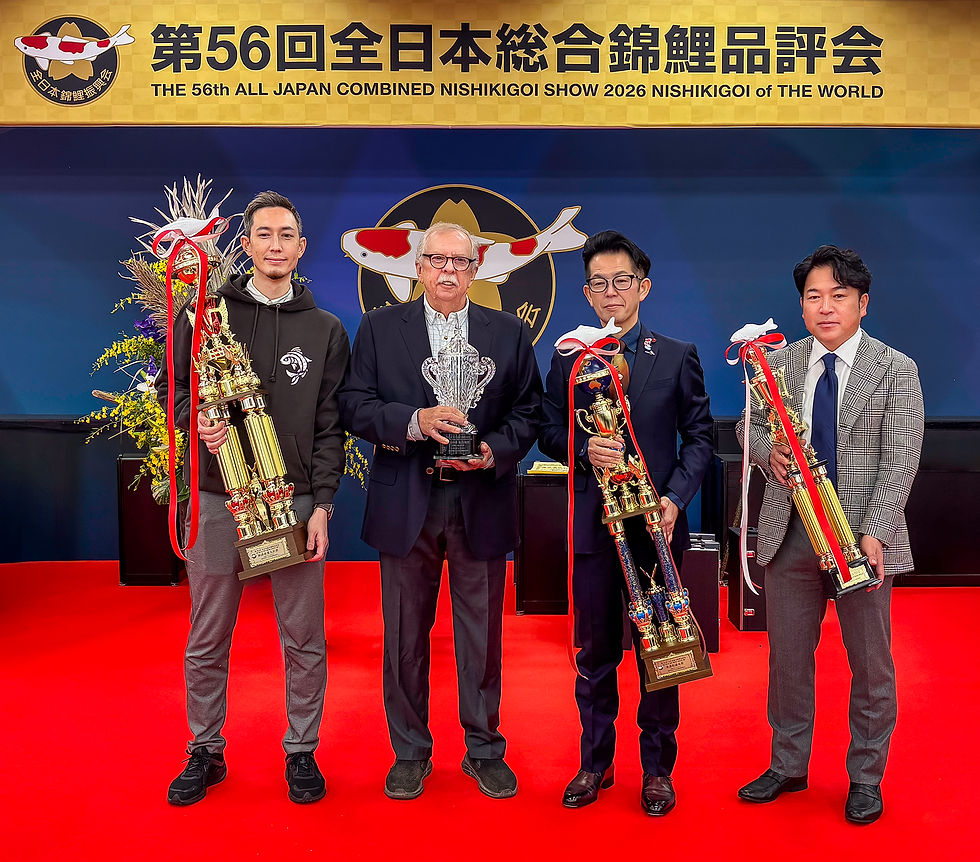
In January 2025 in Tokyo at the All Japan Nishikigoi Show, Herb received the Miyabi Award for a 60 bu Showa bred by Isa Koi Farm. The same koi also won its 60 bu Showa class. Additional results included a first-place finish for a 95 bu Hikari Kawari, along with further class wins and runner-up placements.
Next came the 27th Central Florida Koi Show. Herb earned another Grand Champion title with a koi bred by Sakai Fish Farm, purchased from Narita Koi Farm and handled by Fitz’s Fish Ponds.
Back in Japan in March 2025, a 33 bu Momotaro-bred Sanke owned by Herb won a Kokugyo Award at the 41st All Japan Young Koi Show. Kokugyo is commonly referred to as the National Fish Award in Japan. Additional Fritch-owned koi earned runner-up placements in their classes.
At the All-American Koi Show in Las Vegas, one Fritch-owned koi was named overall Grand Champion, while three others became Mature, Young and Baby Champions. Additional Kokugyo and special awards extended those results across several sizes, varieties, breeders and dealers.
The record expanded further in 2026

At the All Japan Combined Nishikigoi Show, Herb’s 95 bu Kohaku became Grand Champion of the Large Koi Division, while a male 75 bu A Ginrin won the Giant Male Koi Division. Champion of the B award, a prestigious win was also done at the 2026 event. These titles weren't the overall championship, but substantial victories on a Japanese stage where koi are compared against some of the most carefully bred and prepared specimens in the world.
Only weeks later, an 85 bu Dainichi Showa owned by Herb won the overall Grand Championship at the first AJNPA AI Koi Show. His 63 bu Kanno Goshiki then received Grand Champion B at the All Japan Young Koi Show.

By June, the record had reached the 2026 All Vietnam Koi Show in Ho Chi Minh City, where his 84-centimeter Kohaku was named Grand Champion and his 83-centimeter Ginrin Kohaku was named Grand Champion B.
These results do not represent every koi show in which Herb’s fish have competed. One part of the broader record, however, stands apart: winning entries at four different koi shows in four countries—Indonesia, Vietnam, Thailand and the United States.
Few collectors and teams can point to those types of international results.
Understanding Koi Show Results
Award Level | Correct Interpretation |
Overall Grand Champion or Reserve Grand Champion | The highest or second-highest result in the complete show, unless the show uses separate A and B championships. |
Grand Champion A, Grand Champion B, International Grand Champion or sectional champion | A major championship within a defined division. It is not necessarily part of the overall first-through-third podium. |
Kokugyo, Best in Size, Best in Variety and special named awards | Recognition as the strongest koi within a size, variety or special judging category. |
Gold, Silver, Bronze, first or runner-up | A class-level placement within a particular size and variety. |
A Chain of Breeders, Dealers and Handlers
The deeper story, however, is not only about ownership.
Official show results repeatedly connect Herb’s koi to breeders including Dainichi, Sakai Fish Farm, Momotaro, Kanno, Isa, Marudo, Hosokai, Matsue, Marusei, Hiroi and others.
Dealers, agents and handlers such as Narita Koi Farm, Grand Koi LLC, Fitz’s Fish Ponds and several international partners were also involved at some level in the handling, sale, transportation or care of Herb’s winning koi.

In the koi world, a show result is rarely the work of one person. It begins with the breeder who understands a bloodline, continues through selection and development, and depends upon years of care, conditioning and judgment.
Herb Fritch’s record is strongest when told that way—not as a list of unsupported claims, but as a documented chain of koi, breeders, handlers, dealers and shows extending from American exhibition halls to Japan and Southeast Asia.
A New Phase in Tennessee
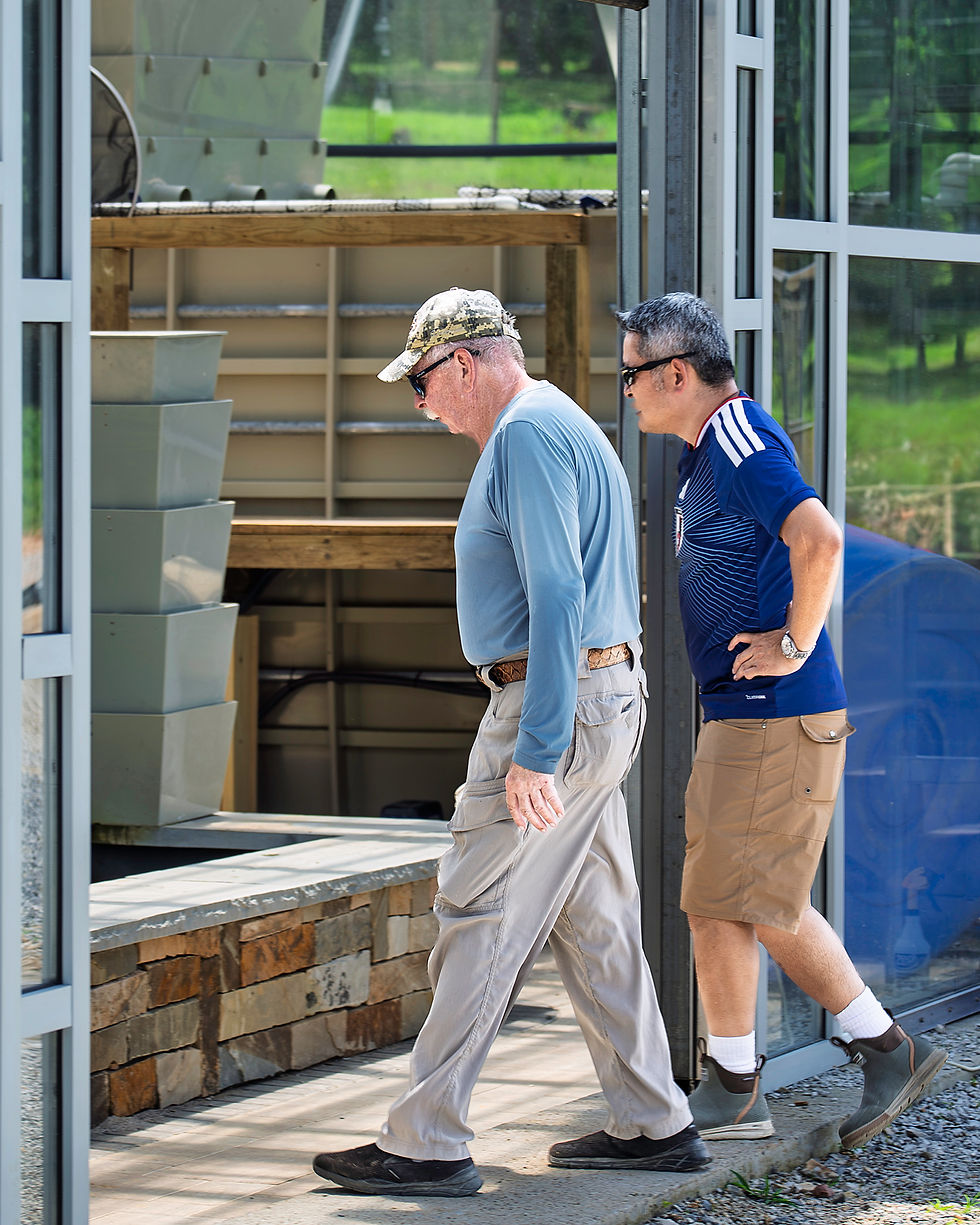
A successful businessman does not ignore mistakes. As 2026 began, changes were implemented at Herb Fritch’s koi farm in Middle Tennessee. Herb needed a team leader.
“Bringing Duc on board has added experienced leadership to the team of dedicated individuals with a lot of tropical fish experience but very little koi experience,” Herb said during my interview. “We are making progress assimilating the new koi, cataloging my collection, and evaluating which koi have show level quality.”
That experienced leadership comes from Duc Nguyen.
Introducing Duc Nguyen
Duc’s journey in koi began in 2004 with the construction of his first pond. As he moved throughout the United States and later to Japan, he remained active in several koi clubs, helping with shows and serving in leadership positions.
He entered the ZNA judging program in 2012 and became a locally certified judge in 2014.
Living in Japan from 2014 through 2019 gave Duc the opportunity to attend shows and seminars, work alongside members of the koi community and study many of the finest Nishikigoi in Japan. He achieved Assistant Certified Judge status in 2017 and became a Full Certified Judge in 2019.
Since then, Duc has judged shows in the United States, Europe, Australia and across Asia, including Japan. In Japan, he became the first non-Japanese judge appointed to serve as head judge of a koi show.
He was also one of only three non-Japanese certified ZNA seminar instructors. Duc served as ZNA U.S. District Chairman until resigning in June 2026 to join Herb in Tennessee.
Experience Beyond the Koi Show
Duc’s koi experience is only part of what makes him uniquely qualified to take on the work at Herb’s farm.
He spent 29 years at Danone Foods, working in research and product development around the world. Duc retired in February 2026 as Vice President of Research and Innovation managing a $3 billion portfolio.
His full attention is now focused on the world’s largest private koi farm. It's not only Duc at Herb's; it's also a team that has been there since the beginning, which includes Adam Vaughn, Jeff Street, and Chris Richards. Together, the four of them are on site daily.

When I asked Duc about his focus in Tennessee, his answer came down to one word: “Efficiencies.” It was the answer of an experienced leader. At a facility of this size, inefficiency and waste can consume capital quickly. The errors made in pond construction consume both money and time. Running unnecessary pumps and filters adds further expense because the energy required to power them is not free. In Reality that energy can cost in the area of seven figures annually.
Six years is a short time in which to accomplish all that has been done in Middle Tennessee. Now time is being spent rebuilding rather than enjoying what was already created. You do not have to be an actuary to understand that time is money. Time is also life moments.
Refining the Collection
Beyond improving efficiency in facility management, there is the task of refining Herb’s collection into the best of the best.
That takes time. It also requires the judgment that a ZNA-certified judge with global koi experience can offer.
The work involves assimilating new koi, removing unnecessary koi, cataloging the collection and determining which fish have true show-level quality. It is a different phase for the farm—one focused not only on continued growth but also on evaluating what has already been assembled.
What the Future Holds
Together, Herb Fritch and Duc Nguyen hope to show what is possible when passion and capital come together to make an impact on the world of koi. The collection at Herb’s is world class, soul stirring.
In Japan, koi are Nishikigoi—the Living Jewels—and a cultural part of what makes Japan, Japan. To the world, koi are things of beauty, gliding through the water in a way that mesmerizes.
To all who own koi, breed them, collect them or simply love seeing them in a Japanese garden, Koi Waters Online Magazine hopes your journey is a joyous one.
Herb Fritch is always on site feeding his Koi Daily. Herb uses Sakai fish paste for his large, prized Koi Beautiful Koi are everywhere at Herb Fritch's place Koi in a natural spring fed pond on property at Herb Fritch's Koi Farm Mixed koi and goldfish in a natural spring at Herb Fritch's The new Alley Ponds at Herb Fritch's Private Koi Farm A treatment pond in the original pond building at Herb Fritch's Fish care includes checking for disease and parasites using medical microscopes Herb Fritch relaxing at his Pond House near it residence in Tennessee