Silk on the Sidewalk: Kyoto’s Kimono Rentals

Why Kyoto’s kimono-rental boom keeps colliding with a living Geisha tradition
By late morning in Higashiyama, the transformation is already underway. A row of sandals sits at the entrance of a kimono rental shop like punctuation marks. Inside, sleeves are smoothed, collars are tightened, obi knots are pulled into place with practiced force. A visitor turns toward the mirror and meets a version of Kyoto they’ve carried across an ocean: brocade, bright patterns, hair ornaments, the promise of old streets and lantern light.
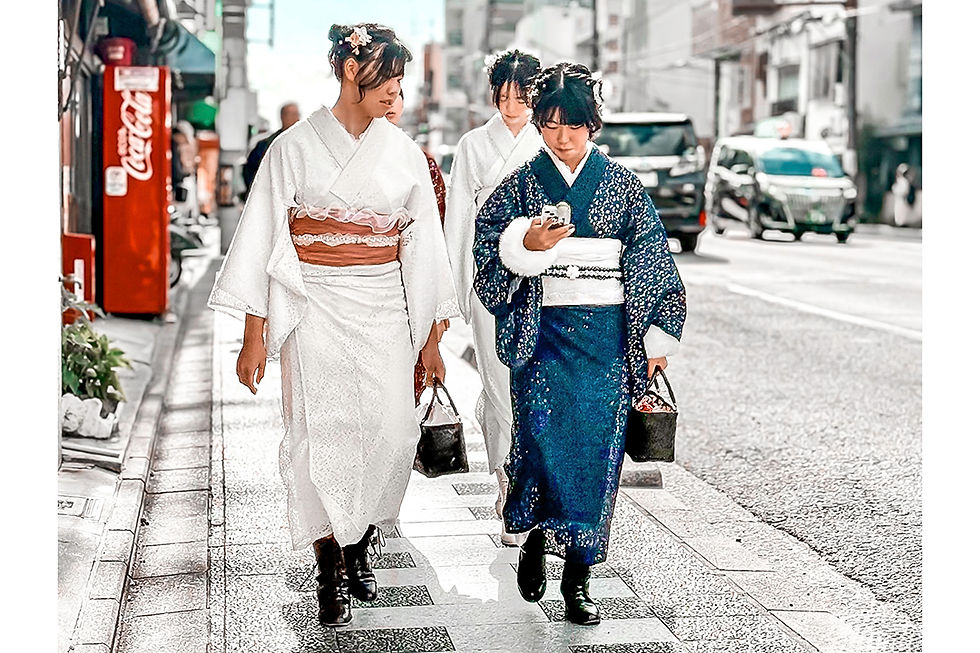
Then the door slides open, and the city receives them as, Silk on the Sidewalk: Kyoto’s Kimono Rentals tourists. Dozens, sometimes hundreds, in rented kimonos moving between shrine gates and cafés, pausing for photos on stone steps, drifting toward the most photogenic lanes as if guided by an invisible magnet.
This is not unusual anymore. It’s become part of Kyoto’s daily rhythm, especially along the well-worn routes leading toward Kiyomizu-dera, Yasaka Shrine, and the edge of Gion. And yet the deeper you walk into the old quarters, the more complicated the costume becomes.
Because in Kyoto, there is a difference between wearing tradition and being it.
The word “geisha” isn’t the whole story
A Geisha is not a mascot. She is, at her core, a professional entertainer, trained in conversation, music, and dance. She is expected to carry herself with a precision that reads as effortless, only because it has been practiced into her bones. Encyclopedia Britannica describes Geisha as a professional class of women whose traditional occupation is entertaining, with skills like singing, dancing, and playing the shamisen as essential to the role. Encyclopedia Britannica
Just as important: the geisha system did not arise as a synonym for sex work. It began, roughly, with the 17th century as a class of entertainers set apart from courtesans and prostitutes—separate roles in Japan’s historical pleasure quarters.

Kyoto adds another layer: here, the word you’ll often hear is geiko (geisha) (and maiko for apprentices). Gion Corner, Kyoto’s long-running theater for traditional arts, spells it out plainly: Kyoto’s “ancient capital” is home to five kagai (entertainment districts), and it’s in these districts that Geisha practice dance, song, music, tea ceremony, and hospitality as working professionals. Gion Corner
So when tourists say they want to “walk like geisha,” what they’re really brushing against is a living profession—one that still relies on privacy, introductions, and boundaries to function.
Gion: built for pilgrims, famous for restraint
Gion didn’t become Gion because it was picturesque. It developed as a town near the gate of Yasaka-jinja Shrine, and grew into a place where entertainment and hospitality took root alongside the city’s religious and cultural pulse. Kyoto’s official travel guide describes the area as a popular entertainment district where geiko and maiko live, set among tea houses, restaurants, and the steady traffic of visitors. Kyoto Travel
In other words, Gion is not a stage set. It’s a neighborhood with a purpose; historic, commercial, residential, and still deeply tied to the rhythms of work. And because it is so famous, it is also fragile. Kyoto’s official guide doesn’t mince words: the Gion area is one of the city’s most popular destinations, and taking pictures of Maiko without permission is “strictly prohibited.”
When kimono becomes costume, pressure follows
Kimono rental itself isn’t a trivial side business; it’s woven into modern tourism and ceremonial life. Japan’s Agency for Cultural Affairs notes that kimono rentals are often used for coming-of-age ceremonies, graduation ceremonies, and sightseeing.
Kyoto is a city where tourism isn’t marginal, it’s structural. The Kyoto City Tourism Association’s official site reports that tourists spent roughly 1.2 trillion yen in Kyoto in 2019, generating about 800 billion yen in added value—equivalent to approximately 12% of the city’s total GDP.
Vintage Kimono Shop in Kyoto Kimono Rental Shop in Kyoto Japan
This is the knot Kyoto is trying to untie: tourism is an economic engine, but it concentrates pressure on precisely those places, like Gion, where the city’s cultural identity is most exposed.
So yes, kimono rentals help pay rents, employ staff, and keep shops alive. But the “geisha vibe” tourists chase can also drag working Geisha and Maiko into a kind of unpaid performance: being followed, photographed, and treated as if they exist for public consumption.
The etiquette campaign that had to be written down
Kyoto, famously, prefers manners that don’t need signage. Gion, in 2025, has signage.
Kyoto’s Responsible Travel page, written as a message from Southern Gionmachi, asks visitors not to stop, touch, follow, or take unauthorized photos or videos of geiko or maiko, then drives the point home with a sentence that reads like a cultural correction as much as a warning: “The geiko and maiko are not mascot characters.”
This is where the romantic story tourists tell themselves, Kyoto as a timeless movie set, collides with the real one: the city is asking, publicly and explicitly, for people to behave like guests in a lived-in place, not consumers in an attraction.
When “overtourism” becomes a policy, not a complaint
The tension in Gion has grown loud enough to become formal restriction. In April 2024, Kyoto began putting up signs to stop tourists from entering certain private alleys in Gion, warning that unauthorized passage could result in a 10,000 yen fine.

The Guardian newspaper reported on Kyoto’s plan to ban tourists from parts of Gion’s alleyways, describing the move as a response to overcrowding, intrusive behavior, trespassing, and relentless photography—while noting that Hanamikoji Street, Gion’s main thoroughfare, would remain accessible. The Guardian
The subtext is: Gion is pushing back not because it hates tourists, but because tourism, unchecked, turns human beings into props and neighborhoods into backdrops.
The illusion tourists buy—and the city must live with
A rented kimono can be a bridge. It can slow a visitor down, make them more aware of posture, season, fabric, and the quiet discipline of dressing well. Done respectfully, it’s not mockery, it’s admiration expressed through participation. But the moment a visitor’s goal becomes “looking like a geisha,” the bridge turns into something else: a shortcut that flattens craft into costume.
Geisha and Maiko aren’t “Kyoto aesthetics.” They are trained artists working inside one of Japan’s most carefully structured cultural ecosystems, concentrated in districts that still guard their traditions with a blend of artistry and rules. Gion Corner’s description of the five Kagai makes that structure visible: these districts are professional worlds where Geisha practice arts of performance and hospitality, not street theater for passersby.
Kyoto, in its most Kyoto way, is trying to preserve that world without turning it into a museum. The city’s own tourism writing admits the lingering reality: even with improvements to lodging and transportation, congestion and bad manners haven’t been fundamentally solved.
What remains, if Kyoto gets it right
It is possible that tourists keep renting kimono, but they treat it as clothing, not a disguise. They walk the streets the way Kyoto asks people to walk: not in the middle of the road, not blocking traffic, not turning narrow lanes into photo studios.
A glimpse of a Maiko is what it has always been: fleeting, unclaimed, and therefore all the more beautiful. You don’t chase it. You let it pass, because it was never meant to be captured.
Kyoto’s old ways have survived fires, wars, political shifts, and the long erosion of modern convenience. Gion is reminding the world of that truth—one sign, one restricted alley, one boundary at a time.
All photos and story by Kevin Warren ©KoiWaters2025
Young Couple in rental Kimono's walking the streets of Kyoto, Japan Young women in rental Kimono's along the streets of Kyoto, Japan A simple bow knot on the back of a Kimono A more intricate Taiko-musubi style knot on a Kimono Young women in Kimono's mix with school girls on the streets of Kyoto a group of women wearing rental Kimono's, Kyoto Japan A young couple in Kimono's on the crowded streets of Kyoto Sample Kimono's for rent or sale outside a shop in Kyoto, Japan Geisha on a public train platform at Kyoto Station, Kyoto Japan